Dentures That Stay
Where They're Supposed To.
Implant-secured dentures lock onto 2–4 titanium anchors for a confident, stable fit. No adhesives. No slipping. No embarrassing moments at the dinner table.
- Removable for easy cleaning — snaps in and out
- As few as 2 implants per arch
- Dramatically more stable than traditional dentures

What It Is
The Middle Ground Between Dentures and a Full Fixed Arch
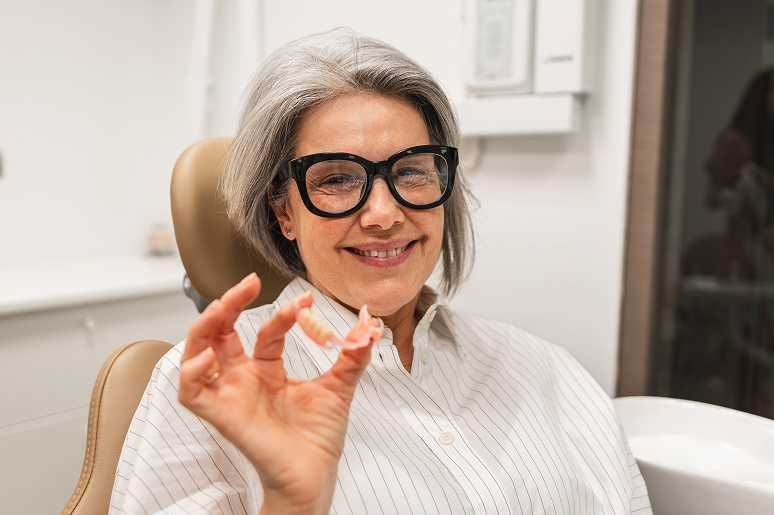
Snap-in dentures (also called implant-retained or implant-supported overdentures) are a removable denture that attaches to small titanium implants using locator abutments — like a snap button. When you press the denture down, it clicks firmly into place. When you want to remove it for cleaning, it releases easily.
This gives you the stability of an implant-anchored solution at a more accessible cost than a fully fixed full-arch restoration. The implant anchors also stimulate bone, preventing the shrinkage and facial collapse that traditional denture wearers experience over time.
- Significantly more stable than conventional dentures
- Preserves bone at implant anchor sites
- Removable for simple daily cleaning
- More affordable entry point into implant dentistry
- Can be upgraded to a fixed arch in the future
Is This Right for You?
Who Is a Good Candidate for Snap-in Dentures?
If you're frustrated with traditional dentures but want a more affordable alternative to a fully fixed arch, snap-in dentures may be the right step — now or as a path toward a more permanent solution.
- Currently wear full dentures and are unhappy with the fit
- Are missing all teeth in an arch
- Want more stability than traditional dentures provide
- Prefer a removable option for ease of cleaning
- Want implant-supported stability at a lower starting cost
- Have adequate bone for at least 2 implant anchor sites
- Some bone loss — mini implants or strategic placement may be used
- Worn dentures for many years without implants
- Sore spots or ill-fitting current dentures
- Gum shrinkage from long-term denture use
- A desire to eventually upgrade to a fixed arch — we plan with that in mind
The Process
How Snap-in Dentures Are Placed
A cone beam CT scan maps your bone volume and density. Dr. Pasicznyk identifies 2–4 ideal anchor sites and determines whether your existing denture can be retrofitted or a new one is needed.
2–4 small titanium implants — called locator implants — are placed in the jawbone under local anesthesia. Healing caps are placed on top while the implants integrate with your bone.
Over 2–4 months, the implants fuse with your jawbone. You continue wearing your existing denture (modified to avoid contact with implant sites) during this period.
Locator abutments are placed on the implants. The denture is then fitted with corresponding female attachments that snap firmly onto the abutments.
We fine-tune the fit, bite, and comfort. You leave with a denture that clicks in firmly, stays secure during eating and speaking, and releases easily when you want to clean it.
The snap-lock connection to your implants means your denture doesn't shift when you chew, laugh, or speak. No adhesives, no embarrassing slips — just confidence.
Remove your denture nightly, brush it normally, and clean around the implant abutments. No complex tools required — just simple care that fits into your existing routine.
Snap-in dentures cost significantly less than a full fixed arch while delivering major improvements in stability and bone health. It's a meaningful upgrade — and can serve as a stepping stone to a fully fixed restoration down the road.
Common Questions
Snap-in Denture FAQs
Traditional dentures rest on the gum tissue and rely on suction or adhesives to stay in place. Snap-in dentures physically lock onto titanium implants in your jawbone. The difference is dramatic — patients describe it as going from loose and unreliable to solid and natural-feeling. You can eat foods you've avoided for years.
The lower jaw typically requires 2 implants for a stable overdenture. The upper jaw often requires 4 because it has less bone density. Dr. Pasicznyk will assess your bone and determine the optimal number at your consultation to ensure a long-lasting, secure result.
In some cases, your existing denture can be modified to work with your new implants — saving time and cost. However, if your current denture is old, poorly fitting, or not ideal in its design, a new prosthesis may serve you better in the long run. Dr. Pasicznyk will review this with you at your consultation.
Yes — the nylon inserts (female attachments) inside the denture do wear down over time and typically need replacement every 1–2 years. This is a simple, low-cost chairside procedure. The titanium implants and abutments themselves do not wear out.
Often, yes — depending on how many implants were placed and their positions. If we plan with a future upgrade in mind (placing implants in locations that would also support a full fixed arch), the transition can be straightforward. Discuss this goal with Dr. Pasicznyk at your consultation so he can design your initial treatment with that pathway in mind.
Cost depends on the number of implants, whether a new denture prosthetic is needed, and whether any preparatory procedures are required. We provide complete, transparent pricing at your consultation — and offer flexible financing options. Call us or book online to get started with your personalized treatment plan.
Get Started Today
Tired of Dentures That Don't Stay?
Schedule a consultation and find out if snap-in dentures are right for you. We'll review your bone health, explain your options, and give you clear pricing — no surprises.